Showing posts with label open evaluation. Show all posts

September 30, 2016

Open Science in practice 4S EASST conference Barcelona, Sept 1st 2016

Open Science (OS) is currently regarded as the next ‘big thing’ in European science policy and elsewhere. It is defined as science that is transparent, accountable, and shareable, involving the participation of (all) relevant stakeholders in the scientific process. In practice, tensions are emerging in how OS is enacted by scientific communities, science policy organisations, funding bodies, the publishing industry, and science-related institutions, with diverse uptakes of commons, knowledge sharing, democratisation of technology, participatory design, hacking etc.

This conference stream invited STS scholars to explore OS from an STS perspective and to discuss what STS can bring into the broader discussion of OS, e.g. by studying institutionalizations of OS, appropriations of OS within prevailing traditional images of science, or how OS is co-shaped by negotiation processes promoted by different stakeholders. Presentations covered socio-technical dimensions of openness in sciences - including the social sciences and humanities - in general and Open Access, Open Research Data, Open Methods, Open Education, Open Evaluation, and Citizen Science in particular.

(Session reports by chairs)

February 11, 2016

Disembodying academic (re-)production?

A self-reflexive Game

           
Prior to posting some more theoretic reflections on why Open Science and regimes of individual qualification and evaluation are by large incompatible I would like to propose to you an Open Experiment or Game on the ways in which we make use of the embodiement of scientific output. 

January 7, 2016

Open Research Data?

This Blogpost, aiming at compiling a definition of Open Research Data, highlighting the implactions Open Notebook Science has on scientific practices and discussing the issues on how reputation regimes in academia for the moment are unable to keep track with developments in research practices, has been started in the context of the University of Seminar Open Science, the better science? with Katja Mayer. As such one of the characteristics of the text is the fulfillment of the formal and contentual requirements of the course. Second the text also aims at being an experiment in synchronous reviewing. Thus it has initially been published in an early stage of process and will be completed and edited. This is why I would like to invite you to openly comment on the text and start an open synchronous review experiment here.

October 1, 2015

A course on Open Science - why now?

"What science becomes in any historical era depends on what we make of it" (Sandra Harding)
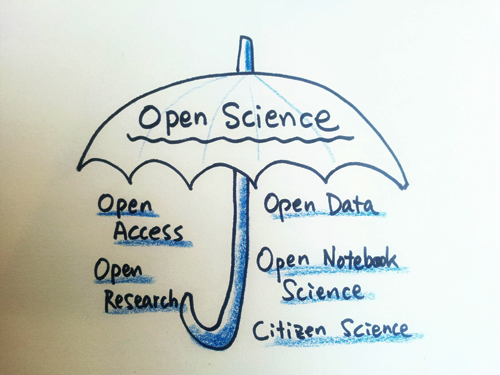
Open Science 우산 | by eotls4387


The idea to create a course on issues in Open Science practices came in 2014, when I tried to grasp the diversity of concepts under the umbrella term of Open Science. Then, a public consultation was launched to collect perspectives on Science 2.0, its benefits and challenges.


Furthermore, at that time we witnessed global turmoil in the relationships between universities and publishing houses.

Last but not least, Open Science and the advancement of Open Access to publications and research results will be one of the priorities of the Dutch Council presidency of the European Union in 2016. Besides renegotiating transparent contracts with scientific publishing houses, emphasis will be on the legal necessities and modifications to existing legal frameworks to make copyright legislation better suited for Open Science, with special regard to the question of re-usability of copied or recorded materials.

Suddenly Open Science became a buzzword that made its long term advocates wonder how fast professional buzzword compliance and open-washing will take over....

In any case, Open Science promises to be a rich resource for STS inquiry. We can start by looking at the policy imaginiaries currently at work.